Japan

Japan

domingo, 9 de noviembre de 2014

ROAD INFRASTUCTURE

When thinking of driving in Japan, most of you might imagine congested highways in the megacities. While generalizations have to be taken with a grain of salt, this is actually a fairly accurate image of traffic in Japan. 

Road Infrastructure in Japan
There are over 1.2 million kilometers of roads in Japan, about 7,500 of which are expressways. As Japan is technologically very advanced, most national roads and expressways have electronic speed limit and notice signs. They keep you up-to-date on congestions and accidents, two of the daily side effects of driving in Japan.

The Japan Automobile Federation
The Japan Automobile Federation (JAF) provides a traffic rules booklet in five different languages, which offers information on what specifically is different about driving in Japan. 

The JAF also provides roadside assistance to its members. Generally speaking, it aims to improve the quality of the environment, roads, and the overall experience of driving in Japan. Joining the JAF could prove to be a good idea for motorized expats.

martes, 16 de septiembre de 2014

MYTHS AND LEGENDS

The mythology of Japan has a long history dating back more than 2,000 years. It became part of two major religious traditions: Shinto, an indigenous religion, and Buddhism, which developed in India and came to Japan from China and Korea.

Sources 
For many centuries myths were transmitted orally in Japan.
1) KamaitachiKamaitachi, literally means "sickle weasel." There are three of them, sometimes brothers, sometimes triplets, who go around cutting off people's legs. The first weasel knocks someone down, the second cuts off the legs, and the third sews up the wounds. They move so fast basically people blink and then suddenly realize they no longer have legs. Admittedly, the fact that one of the weasels takes the time to patch people up before absconding with their limbs helps. But, if the idea that you could suddenly discover that weasels have stolen your legs doesn't scare you, then you're a better man than I.
2) Joro-GumoThe Joro-gumo is a spider-woman, but she's not a member of the Avengers with a needlessly complicated backstory. She's a giant spider, with the ability to take the form of a beautiful lady (sometimes the top half is human, and her lower torso is that of a spider) who seduces men, wraps them up in her webs, poisons them, and eats them. One variation of the Joro-gumo myth says that sometimes she appears as a woman holding a baby, who asks men passing by to hold it. When they do, they are someone surprised to discover the "baby" is made up of thousands of spider-eggs, which burst open.
3) Teke TekeTeke Teke is more of an urban legend than a regular myth, as it's reasonably new. She's the spirit of a girl who tripped on some train tracks and was cut in half by an oncoming train. Now she crawls around looking for other people to share her fate, which she facilitates by cutting them in half with a scythe. There's a variant of the Teke Teke myth about a girl named Reiko Kashima, who was also cut in half by a train; now she wanders bathroom stalls and asks people on the toilet if they know where her legs are. If people don't answer with "The Meishin Railway," she cuts off their legs, which is bad at the best of times, let alone when you're trying to poop.
4) GashadokuroThis spirit is pretty simple — it's a giant skeleton made of of the bones of people who have died from starvation. They wander around, grab you, and bite your head off, drink your blood, and add your skeleton to the pile.
5) KatakirauwaThe ghosts of baby pigs which 1) have one ear 2) cast no shadow and 3) steal your fucking soul if they manage to run between your legs. I think I'd rather be chased by the giant mass skeleton that a bunch of tiny squealing dead baby pigs, thank you.
6) Aka MantoAnother one of the many, many Japanese ghosts that murder people while they're trying to take a shit, Aka Manto approaches people in bathroom stalls and asks them a simple, if perplexing question: "Would you like red paper or blue paper?" If you say red, your flesh is sliced into ribbons until you're effectively red. If you choose blue, you're strangled to death. If you pick any other color, you're dragged to hell. There's a variant who asks if you want a red or blue cape instead of paper; choose red and the skin is flayed off your back, choose blue and all the blood is drained from your body. The point is never go to the bathroom in Japan.
7) TsuchigumoGreek mythology is known for its variety of mixed-up monsters — e.g. the manticore, which has a lion's body, bat wings, and a human head — but they have nothing on Japan. Meet the Tsuchigumo, creatures with the body of a tiger, limbs of a spider, and the face of a demon. They eat unwary travelers (actually, they eat wary ones as well, I'm sure). Once a powerful Japanese warrior killed a Tsuchigumo and 1,990 skulls fell out of his belly. That's a monster who is frighteningly good at his job.
8) KekkaiChildbirth seems difficult enough before you bring in the possibility that you may give birth to some kind of demon/monster/thing. In Japan, these are called Sankei, and the worst of them is the Kekkai. Basically, instead of giving birth to a baby, a lady gives birth to a lump of flesh and blood and hair, when immediately runs off, straight out of the vagina, and tries to burrow underneath its mother's home in order to murder her later. No wonder Japan's birth rate is declining.
9) OshiroibabaOne of the many, many horrible demon women that apparently wander around the nation unfettered, Oshirobaba is an old crone that goes around asking girls if they'd like to try some of her face powder, like the world's creepiest Avon lady. Taking make-up from strangers is bad idea in general, and taking it from old ladies is even dumber, because the Oshirobaba's powder makes your face fall off.
10) Ittan-MomenThe Ittan-Momen doesn't sound particularly scary; it's basically a sentient roll of cotton that just flies around in the wind at night, wandering around. But the Ittan-Momen is also a sadistic asshole, because if it sees you, it will either wraps itself around your neck and choke you to death, or wrap itself around your head and suffocate you. Again, the idea that you can be walking back from the convenience store and suddenly get murdered by a large piece of cloths is deeply disconcerting to me.

FOOD

TRADITIONAL
  • The Japanese eat a lot of rice, but also a whole bunch of noodle dishes and soups. 
  • Soups, noodles and rice with interesting sauces make for a fine meatless base.
  • There is meat in most dishes in Japan. Even those dishes that look like they don't have meat, often have a chicken or fish stock or some meat-based gravy. Even sushi, which is everywhere and should be able to become fine vegetarian fare, almost always incorporates seafood.


OTHERS
  • There are numerous Italian restaurants that do serve cheese pizzas and vegetarian pasta dishes. Plus, 
  • a lot of French boulangeries with pastries of all sorts. And egg salad sandwiches are prevalent in many cafes and even pre-packaged at a number of convenience stores.
  • Hamburgers seem to be popular in Japan. There are bunches of McDonald's and even some Burger King's. A few Japanese burger chains, such as Lotteria, are numerous, too. While in general, Japanese portions tend to be a lot smaller than American portion

GLOBALIZATION

“This process of internationalization has proceeded at the expense of a loss of Japanese culture and identity among young people. Japan can be said to be witnessing the marginalization of Japanese culture in the name of globalization”


Globalization has benefits and advantages but also there are too much other disadvantages:

  •      Globalization is equated with North Americanization.
  •      It is almost impossible to live in Japan without knowing English.
  •      Adoption of European imperialism resulted in total devastation of both the country and many traditional values.
  •      Following World War II, Japanese culture has been jeopardized very seriously by the Western culture.
  •      Languages were the major obstacles, but English has become an international language both in the real world and the world of virtual reality.

FIRST IMPRESSION

Language

  • The Japanese all study English in school for several years through high school.
  • Even Japanese in busy tourist areas often will not speak English, not even a word. I'm not sure if this is because they cannot or just do not want to try, perhaps due to shyness (I get the impression that public failure, even when trying to communicate, is much worse in Japan than in the U.S.).
  • All the signs are in Japanese.

Transportation


  • Vehicles in Japan are fun. Cars are cute, small and boxy. Trucks are usually tiny.
  • Bycicles are mostly a basic tooling around, getting you from point A to point B with one gear. And no one locks them up. 


    Environment

    • Japan is clean. Extraordinarily clean given the number of people in such a tight space (Japan has about 1/2 the population of the U.S. in a space about the size of California, but with about 70% mountains). 
    • There is almost no trash or graffiti anywhere. And this despite the lack of trash cans in many areas. In fact, the Japanese are very particular about trash, sorting their refuse into complicated piles: burnable, non-burnable, paper, various plastic types, cans and large stuff. 


    TRADITIONAL MUSIC

    In Japan, the music is represented by:
    1.       Sparse rhythm.
    2.       Regular chords are also absent.
    3.       Silence is an important part of the songs.
    4.       Flows in an attempt to mirror the behavior of nature.
    5.       It is regular for songs to start off at an extremely slow pace and to pick up speed as they progress.
    6.       Three main types, instrumental, court music, and theatrical.

    The oldest traditional music is GAGAKU


    Gagaku is a form of court music. Gagaku includes dances, songs, and a blend of other
    genres of Asian music. There are two styles of Gagaku. These are Kigaku, which is a form
    of instrumental music, and Seigaku, which is A form of vocal music.


    RELIGION

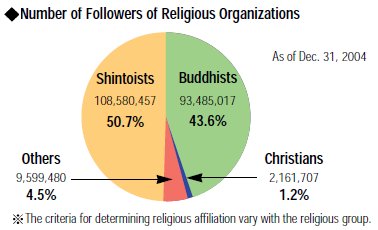
    Shinto and Buddhism are Japan's two major religions. 


    Shinto is as old as the Japanese culture, while Buddhism was imported from the mainland in the 6th century. Since then, the two religions have been co-existing relatively harmoniously and have even complemented each other to a certain degree. Most Japanese consider themselves Buddhist, Shintoist or both.

    Shinto is the indigenous religion which is as old as the Japanese people, and Buddhism was introduced from the Asian mainland in the 6th century. Basically, the two religions have coexisted harmonically for most of Japan's history and have even complemented each other and melted together to a certain degree. The first Christian missionaries entered Japan in the 16th century, but the foreign religion was later banned from Japan for most of the Edo period that lasted until 1868.

    Religion does not play a big role in the everyday life of most Japanese people today. The average person typically follows the religious rituals at ceremonies like birth, weddings and funerals, may visit a shrine or temple on New year and participates at local festivals,  most of which have a religious background.